TL;DR: When someone goes missing, the first priority is an immediate police report. From there, a parallel track of documented, private investigation adds capacity, sustains effort when police resources are stretched, and builds a factual record that can be shared with law enforcement at any time. Canada records between 70,000 and 80,000 missing person reports each year, per the RCMP. Most are resolved quickly, but when they are not, knowing what to do next matters.
The first hours and days after someone goes missing are the most critical for gathering information and preserving leads. This post is a practical guide for families and those with concern for a missing person: what to do immediately, how police and private investigators work, and how a professional missing person investigation supports the search.
What should you do immediately when someone goes missing?
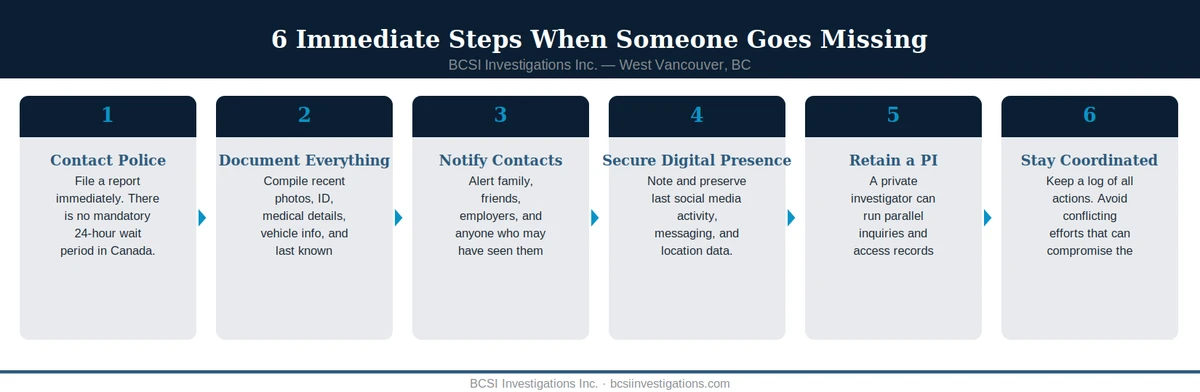
Contact police. In Canada, you do not need to wait 24 hours to report a missing person. That is a myth. Police departments across BC accept missing person reports immediately, and the sooner a report is filed, the sooner the case is entered into the Canadian Police Information Centre (CPIC), making it accessible to law enforcement nationwide.
When you file the report, bring as much information as possible: a recent photograph; physical description including height, weight, hair and eye colour, and any distinguishing features; last known location, date, and time; known associates, friends, partners, and workplaces; any known concerns such as mental health, substance use, or conflict; and access to the person’s phone number, email, and social media accounts.
Keep a written record of everything you report and the officer’s name and file number. This becomes the starting point for everything that follows.
How does a missing person investigation work alongside a police investigation?
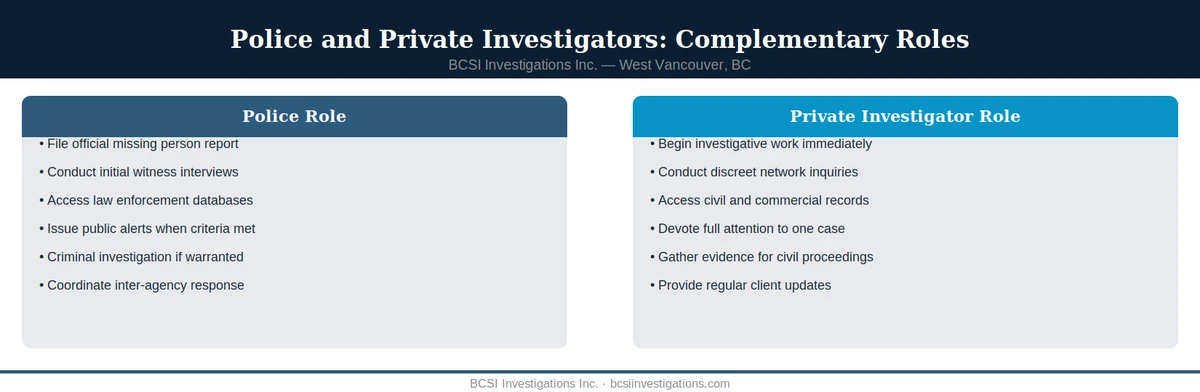
A private investigator does not replace or obstruct police. The two tracks run in parallel, with the private investigator working for the family and providing the family with information, which is something a police investigation does not always do consistently.
In practice, police resources are finite. A large missing person caseload means that some files receive less active follow-up than others. A private investigator retained by the family works on one case, with sustained attention, and reports directly to the family.
The investigator uses tools and access that complement what police have: open-source intelligence (OSINT) research across social media, online presence, and public records; contact with witnesses and associates who may be more willing to speak to a private investigator than to police; financial and records research that identifies the subject’s digital and paper trail; and, where leads connect to a physical location, field investigation.
British Columbia had the highest per-capita rate of missing adult reports in Canada in 2024, at 254 per 100,000 people, per NCMPUR. For families in BC, knowing that professional support is available matters.
What are the most important first steps a family should take?
Secure the person’s digital presence. Note the subject’s email addresses, social media accounts, and phone number. Do not attempt to log into accounts without authority. The digital footprint is evidence, and interfering with it may complicate later investigation.
Contact known associates directly. Friends, workmates, romantic partners, and family members who had recent contact may have information they do not know is relevant. Document what each person says and when you spoke.
Preserve physical evidence. If the person’s home, vehicle, or personal items are accessible, do not disturb them. They may contain information relevant to the investigation.
Issue a public appeal carefully. A social media appeal can generate useful information, but it can also alert someone who may not want to be found or complicate an investigation. Discuss this step with police and, if you have engaged one, your private investigator.
Contact support organisations. In BC, the Missing Children Society of Canada and the BC Coroners Service (where remains may be involved) are relevant contacts. Keep records of all contact and information received.
What information does a private investigator need to start a missing person investigation?
- The subject’s full name, date of birth, and last known address.
- The date and circumstances of the last known contact.
- A current photograph.
- Known associates, relationships, and locations they frequented.
- Whether police have an active investigation and, if so, the file number and contact officer.
- Any prior instances of the person going missing, their resolution, and what changed.
When does engaging a private investigator make the most sense?
- Police have filed an initial report but active follow-up has ceased.
- The family has specific information or leads that have not been pursued.
- The missing person is an adult and law enforcement has limited resources to work the case actively.
- The disappearance appears voluntary but involves circumstances that concern the family, such as a vulnerable person, a conflict, or a sudden change in financial or personal circumstances.
- A locate is the specific objective: the family knows the person is alive but does not know where.
Frequently asked questions
Do you have to wait 24 hours to report a missing person in Canada?
No. This is a persistent myth. Police in BC and across Canada accept missing person reports immediately.
Can a private investigator help find a missing person?
Yes. A licensed private investigator uses legal tools including OSINT, records research, witness contact, and field investigation to trace a missing person’s last known movements, current location, or circumstances.
What if the missing person is an adult who left voluntarily?
Adults have the right to leave without notice. However, if a family has reason for concern, whether due to vulnerability, mental health, coercion, or suspicious circumstances, a private investigator can conduct a lawful investigation to establish facts and confirm the person’s welfare.
How does a private investigator share information with police?
A private investigator works for the family, not law enforcement. However, if the investigation uncovers information that is relevant to a police investigation, the investigator advises the family and their counsel on how to bring it forward appropriately. Obstruction of a police investigation is never an objective.
Is there a time limit on engaging a private investigator for a missing person case?
There is no formal limit, but the sooner a professional investigation begins, the more evidence is available. Witnesses move, memories fade, and digital evidence can be deleted. Early engagement produces better outcomes.
You do not have to navigate this alone
If someone you care about is missing, the uncertainty is one of the most difficult things to carry. A professional, confidential investigation adds sustained effort and a documented record to a process that the family cannot always drive alone. Where children are involved, their safety and wellbeing come first in every decision. To discuss a matter in confidence, request a confidential enquiry. The science of integrated investigations.
About the author: Denis Gagnon is President of BCSI Investigations Inc. and a former RCMP officer with more than 33 years of investigative experience. BCSI is a licensed private investigation firm headquartered in West Vancouver.