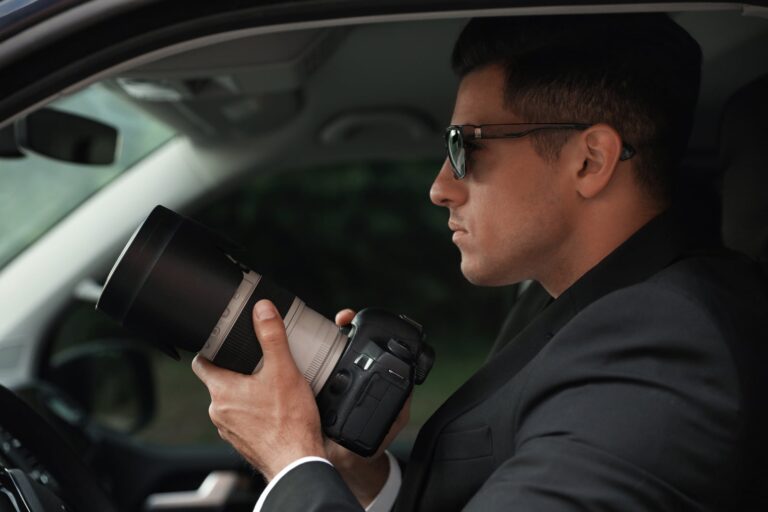
TL;DR: Professional surveillance by a licensed private investigator produces documented, court-admissible evidence through a disciplined, lawful process, not improvised observation. BCSI Investigations conducts surveillance under BC’s Security Services Act, using a structured approach that captures the detail legal, insurance, and corporate clients need to act with confidence. Surveillance evidence that fails to meet evidentiary standards costs clients more in the long run than doing it right the first time.
Surveillance is among the most misunderstood services in private investigation. Ask someone and they may picture a lone figure in a parked car, camera aimed at someone’s front door. The reality, and the difference between evidence that holds up and evidence that does not, lies in the discipline behind the process. At BCSI Investigations, surveillance is a methodical discipline, governed by law, structured by process, and judged by one standard: whether the result can withstand scrutiny.
What is professional surveillance by a private investigator?
Professional surveillance is the systematic, lawful observation and documentation of a subject’s activities in public or semi-public settings, conducted by a licensed investigator in support of a specific legal, insurance, or corporate objective.
It is not general monitoring, harassment, or collection of information for its own sake. Under the BC Security Services Act, a licensed private investigator operates within defined legal parameters, and any surveillance that crosses those boundaries not only fails as evidence but exposes the client and the investigator to liability. Every BCSI surveillance assignment begins with a clear legal mandate: what is being investigated, for whom, to what purpose, and what lawful methods are authorised.
Why does demand for surveillance investigations keep rising?
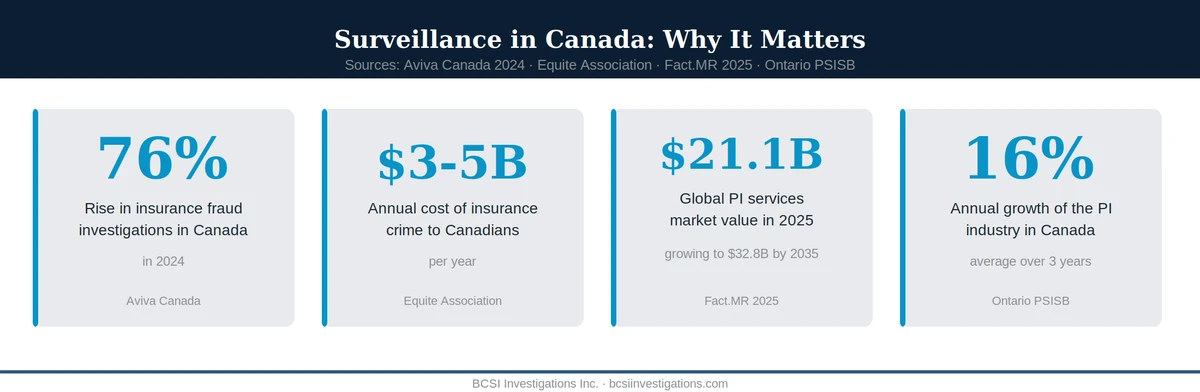
The need for professionally conducted surveillance has grown significantly. According to Aviva Canada, claims fraud investigations rose 76 per cent in 2024, with auto-related incidents accounting for roughly two-thirds of that figure. The Équité Association estimates that insurance crime costs Canadians between $3 billion and $5 billion annually. Corporate fraud cost Canadian businesses over $5 billion in 2024, according to industry data. Those numbers translate directly into demand for documented, defensible evidence.
The global private investigation services market was valued at $21.1 billion in 2025, with North America leading demand, driven by corporate fraud, workplace misconduct, and insurance claim disputes, according to a 2025 market analysis by Fact.MR. In Canada specifically, the industry has grown 16 per cent annually on average over the past three years, per Ontario’s Private Security and Investigative Services Branch.
When insurers, law firms, and corporations need to confirm or refute a claim, surveillance remains one of the most direct paths to objective, documented fact.
What makes surveillance evidence legally admissible in Canada?
Admissibility depends on three factors: lawfulness, documentation, and chain of custody.
Lawfulness means the observation was conducted in areas where the subject had no reasonable expectation of privacy, without trespass, unlawful interception of private communications, or conduct prohibited under the Criminal Code or provincial statute. In BC, this includes compliance with the Security Services Act and respect for the Personal Information Protection Act (PIPA).
Documentation means the evidence is captured in a way that is contemporaneous, detailed, and unambiguous. A surveillance report prepared by a licensed investigator should include time-stamped notes, video and photographic evidence with verified file metadata, and a narrative that connects observations to the objective of the investigation.
Chain of custody means the evidence can be traced from the moment of capture to its presentation in a proceeding, with no gaps or unexplained handling. Breaks in the chain give opposing counsel grounds to challenge authenticity. BCSI documents surveillance evidence to a standard suitable for legal proceedings.
What types of matters typically require surveillance?
Surveillance serves a wide range of legal and corporate objectives:
Insurance fraud investigations. A claimant asserting a debilitating injury who is observed performing physical activities inconsistent with the claim. Surveillance captures objective evidence for the insurer’s litigation team. Given the 76 per cent rise in fraud investigations noted by Aviva Canada in 2024, documented surveillance has become critical to managing claim exposure.
Litigation support. Counsel preparing for trial or negotiation may need independent corroboration of facts in dispute. Surveillance conducted and reported by a licensed investigator carries greater weight than evidence gathered informally.
Corporate investigations. An employee on disability leave, a suspected breach of a non-compete agreement, or a person claiming to be unable to perform duties may require observation to confirm or refute the position. Surveillance in this context must be scoped carefully to avoid breaching employment law or privacy legislation.
Matrimonial and family law matters. Evidence of a parent’s actual living situation, daily routine, or associations may be relevant to custody or support proceedings. BCSI conducts this work with full discretion, and where children are involved, their safety and wellbeing come first.
Missing persons and subject locates. Once a subject is located, observation may be required to confirm identity and current circumstances before disclosure.
How does a professional surveillance investigation proceed?
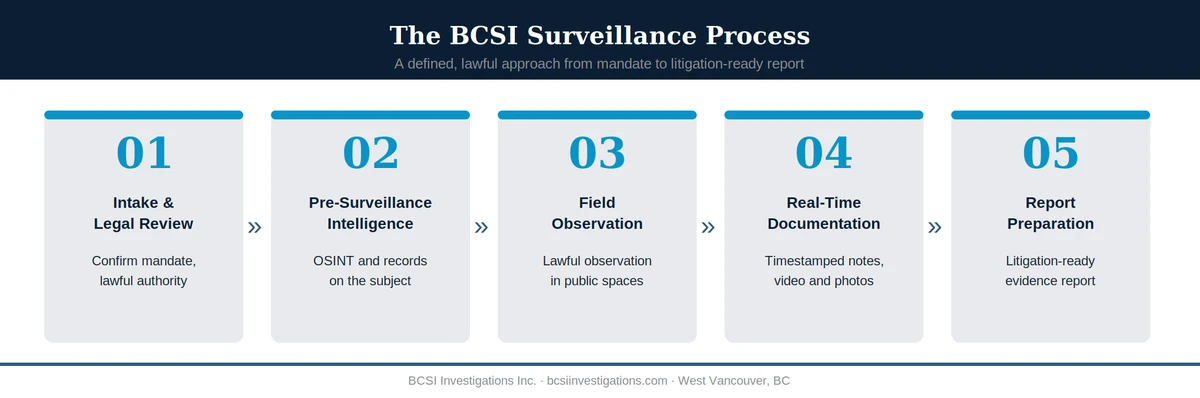
A professional surveillance assignment at BCSI follows a defined sequence. It does not begin with deployment; it begins with analysis.
Assignment intake and legal review. The investigator reviews the mandate, confirms lawful authority, and establishes what information exists about the subject’s likely locations, routines, and activities. Information gathered at this stage determines deployment strategy and reduces wasted time in the field.
Pre-surveillance intelligence. Using open-source intelligence (OSINT) and records research, the investigator builds a picture of the subject’s patterns before the first observation. This phase separates productive surveillance from speculation.
Field observation. The investigator conducts observation in public spaces, using appropriate equipment and techniques to document activity without detection. Surveillance is static (from a fixed position), mobile (following a subject on foot or in a vehicle), or a combination. The choice depends on the environment, the objective, and what the evidence requires.
Real-time documentation. Notes are contemporaneous, recorded as events occur, with accurate timestamps. Video and photographic captures are labelled immediately. Nothing is left to reconstruction from memory.
Report preparation. The surveillance report is the deliverable. It summarises observations, attaches the documented evidence, and is written in plain language that a judge, adjuster, or opposing counsel can follow. It does not offer opinion or interpretation beyond the factual record.
What are the legal limits of surveillance in British Columbia?
In British Columbia, private investigators are licensed under the Security Services Act and regulated by the Registrar of Security Services. The Act defines what investigators may and may not do, and operating outside it creates both criminal and civil exposure.
Key legal limits include:
- Observation is lawful in public spaces where no reasonable expectation of privacy exists. Observation through windows into private residences, interception of private communications, and access to private property without consent are not.
- GPS tracking of a vehicle without consent raises complex issues under federal privacy law and should only be undertaken with proper legal authority.
- Evidence obtained unlawfully is subject to exclusion and may expose the party who directed its collection to civil liability.
A licensed firm applies these limits as a matter of practice, not as an afterthought. BCSI operates under the BC Security Services Act and carries this standard into every surveillance mandate.
A note for clients considering surveillance
If you are considering engaging a private investigator for surveillance, lawfulness and documentation should be the first questions you ask, not afterthoughts. Evidence gathered by an unlicensed operator, or by a licensed one who does not document properly, can be worse than no evidence at all: it can be challenged, excluded, or used against the client who commissioned it.
The right firm asks more questions before deploying to the field than after. It tells you what is realistic, what is not, and why. It delivers a report you can use, not a collection of informal observations that dissolves under scrutiny.
Frequently asked questions
What is surveillance in private investigation?
Surveillance in private investigation is the lawful observation and documentation of a subject’s activities in public or semi-public settings, conducted by a licensed investigator in support of a specific legal, insurance, or corporate objective. In Canada, it is governed by federal and provincial privacy legislation and, in BC, by the Security Services Act.
Can surveillance evidence be used in court in Canada?
Yes, provided it was gathered lawfully, documented contemporaneously with accurate timestamps, and maintained through a clear chain of custody. Evidence gathered unlawfully or without proper documentation is subject to challenge and may be excluded from proceedings.
How long does a surveillance investigation take?
Duration depends on the objective, the subject’s routines, and what the evidence requires. Some mandates are satisfied in one or two observation days; complex or mobile subjects may require multiple deployments. A professional investigator assesses the matter before deployment and advises on realistic scope.
Is it legal for a private investigator to follow someone in BC?
Yes, in public spaces where the subject has no reasonable expectation of privacy. Following someone onto private property, intercepting private communications, or conducting observation in ways that amount to criminal harassment is not lawful. A licensed investigator operates within these limits as a matter of professional obligation.
How do I know if the surveillance evidence will hold up in court?
The clearest indicators are licensing, documentation practice, and experience with legal proceedings. Ask the firm whether their investigators are licensed under the BC Security Services Act, how they document observations, and whether their reports have been submitted in legal proceedings. At BCSI, every report is prepared to the standard our clients’ counsel need to act on it.
Can a private investigator conduct surveillance in insurance fraud cases?
Yes. Licensed private investigators routinely conduct surveillance on behalf of insurers and adjusters investigating suspicious claims. The evidence produced, when properly gathered and documented, supports claims decisions, settlement negotiations, and litigation.
The bottom line
Surveillance conducted by a licensed, methodical investigative firm is a powerful evidentiary tool. Surveillance conducted without discipline, lawfulness, and documentation is a liability. BCSI Investigations conducts every surveillance mandate under the BC Security Services Act, through a defined process led by a former RCMP officer with more than 33 years of investigative experience. To discuss a matter in confidence, request a confidential enquiry. The science of integrated investigations.
About the author: Denis Gagnon is President of BCSI Investigations Inc. and a former RCMP officer with more than 33 years of investigative experience. BCSI is a licensed private investigation firm headquartered in West Vancouver.