
TL;DR: A missing person investigation by a licensed private investigator complements police efforts with focused, documented work across open-source intelligence, records research, witness contact, and subject locates. Between 70,000 and 80,000 people are reported missing in Canada each year, per the RCMP. Most cases resolve quickly, but when they do not, a professional investigator provides the structured, sustained effort that police resources may not always allow. This post explains what a professional missing person investigation involves and what families and clients can realistically expect.
When someone goes missing and police inquiries stall, families are left with unanswered questions and limited information about what comes next. A licensed private investigator does not replace law enforcement in a missing person case. The investigator works alongside it, adding capacity, a different access to information, and a sustained, documented effort that a family can commission directly.
How common are missing person cases in Canada?
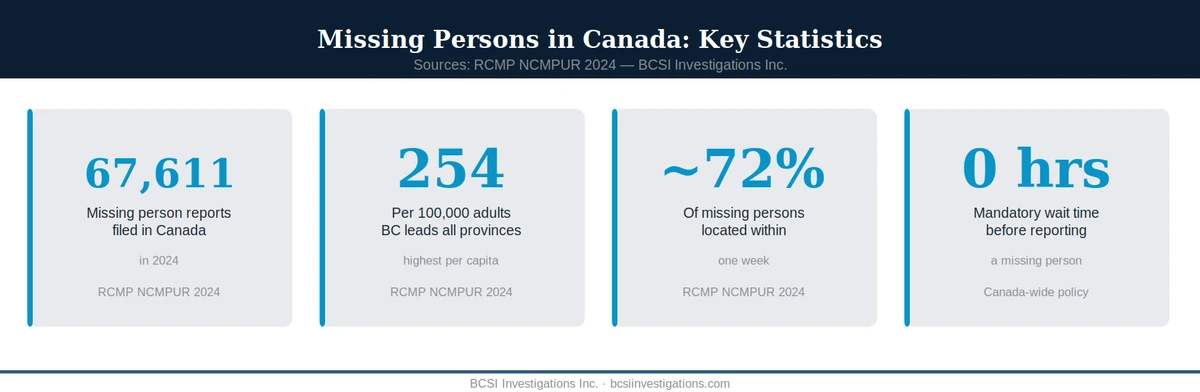
The scale is significant. Between 70,000 and 80,000 people are reported missing to police in Canada each year, according to the RCMP’s National Centre for Missing Persons and Unidentified Remains (NCMPUR). In 2024, NCMPUR recorded 67,611 missing person reports. Most cases are resolved within days: 32 per cent of adult reports are removed from the Canadian Police Information Centre (CPIC) within 24 hours, and 72 per cent within a week, per NCMPUR 2024 data.
But some cases do not resolve quickly. British Columbia had the highest number of missing adult reports per capita in 2024, at 254 reports per 100,000 people. For families whose loved one is among those whose cases remain open, the path forward is not always clear.
When should a family engage a private investigator in a missing person case?
There is no single right moment. Engaging a private investigator early is generally more productive than waiting, because evidence degrades and witnesses become harder to locate over time.
Consider engaging a licensed investigator when:
- A police investigation has reached a standstill and no active follow-up is occurring.
- The family has information or leads they believe have not been fully pursued.
- The person who is missing is an adult and police resources are limited to the initial report.
- The disappearance involves circumstances such as estrangement, financial dispute, or known conflict that the family wants investigated independently.
- A locate is needed: a subject who is alive but whose current whereabouts are unknown.
A locate is different from a missing persons investigation in the classic sense. Many “missing persons” matters handled by private investigators involve individuals who have chosen to cease contact, owe obligations, or need to be served with legal documents. BCSI handles both: genuine missing person investigations and civil or commercial locates.
What does a professional missing person investigation involve?
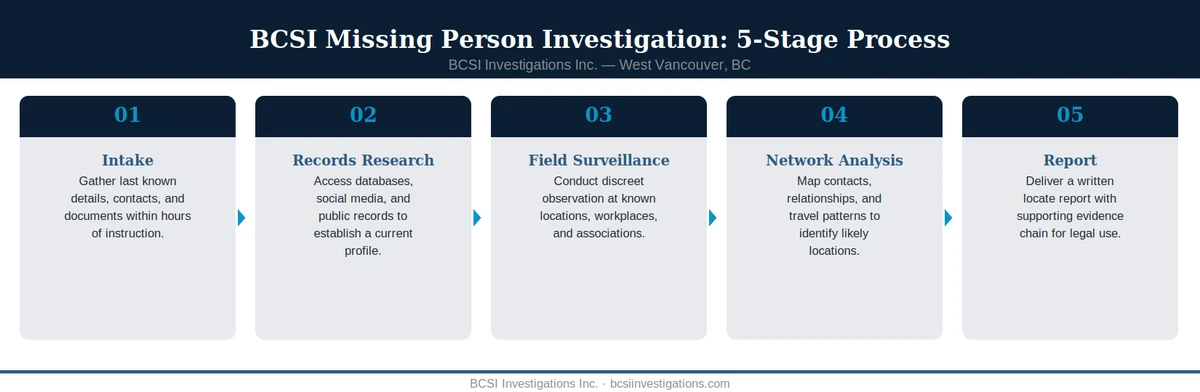
A structured missing person investigation proceeds through several defined phases, each producing a documented record.
Intake and information review. The investigator reviews everything the family knows: the last known location, known associates, financial and digital footprint, social media, employer, vehicles, and any recent changes in behaviour or circumstances. This stage identifies the starting point and the most productive investigative threads.
Open-source intelligence (OSINT) research. Publicly accessible records, social media, online identifiers, and aggregated data sources are searched systematically. A person who has not wanted to be found can leave a digital trail they are unaware of.
Records research. With appropriate authority and consent, the investigator accesses records that locate a person’s connections: property, business, licencing, and public court records, among others.
Witness and associate contact. People who knew the subject often hold information they have not volunteered to police, either because they were not asked, because they are not sure it is relevant, or because they are more comfortable speaking to someone other than law enforcement. A professional investigator approaches these conversations carefully, documenting what is said and how.
Field investigation. Where a lead connects to a physical location, a field investigator follows it, observes, and documents.
Coordination with law enforcement. A private investigator does not obstruct police work. Where the investigation surfaces information that law enforcement needs, the investigator and counsel advise the family on how to bring it forward appropriately.
What can a private investigator find that police may not?
The difference is usually resource focus and access, not capability. A large police service may have many open files and limited capacity to work any single case actively. A private investigator retained by the family has one client and can dedicate sustained attention to one case.
Private investigators also bring a different set of tools to records and digital research that, in some circumstances, uncovers connections that a police database search does not. And because the investigator is working for the family, the family receives regular updates and a documented record of what has been learned, something that is not always available through a police investigation.
What are the limits of a missing person investigation?
Honesty matters here. A private investigator cannot compel anyone to provide information, cannot access restricted law enforcement databases, and cannot trespass, harass, or conduct surveillance in ways that would be unlawful for any investigator. The investigator cannot guarantee that the subject will be found.
What a professional investigator can guarantee is a rigorous, lawful, documented process and clear reporting at every stage. If a lead does not produce results, that is documented too. The family knows what was tried and why it did not succeed, rather than wondering whether anything was being done.
What happens after a person is located?
Locating the subject is the beginning, not the end. Depending on the circumstances, the next steps may include confirming the subject’s identity and current situation, determining whether contact is safe and appropriate, and advising the family on how to proceed, including through counsel if there are legal dimensions.
In some cases, the locate is the primary objective: a creditor, a party to a legal proceeding, or a beneficiary of an estate needs to be found. In others, the family wants the subject to know they are missed and that there is a path back. BCSI handles both with equal discretion.
Frequently asked questions
Can a private investigator find a missing person in Canada?
Yes. A licensed private investigator uses open-source intelligence, records research, witness contact, and field investigation to locate subjects who are missing, estranged, or hard to find. The investigator works within the law and complements rather than replaces police efforts.
Should I hire a private investigator if my family member is missing?
It depends on the circumstances. If police have an active investigation, a private investigator can add capacity without interfering. If a police investigation has stalled or if the missing person is an adult and resources are limited, engaging an investigator directly ensures that sustained effort continues.
What is a locate investigation?
A locate investigation is focused on finding the current whereabouts of a specific individual. It is used in missing person matters, legal proceedings where a party needs to be served, debt collection, and estate administration. A private investigator uses legal, non-coercive means to find the subject’s location.
How long does a missing person investigation take?
Duration depends on how much information exists about the subject’s last known circumstances, how recently they went missing, and how actively they may be avoiding contact. Some locates are completed in days; others require sustained effort over weeks. The investigator will advise on realistic scope during the initial consultation.
Does BC have the most missing person cases in Canada?
BC had the highest number of missing adult reports per capita in 2024, at 254 per 100,000 people, according to NCMPUR data. This reflects the province’s geography, population mobility, and specific vulnerability factors.
A note for families
Uncertainty about a missing loved one is one of the most difficult experiences a family can face. A confidential, professional investigation does not replace the work of police, but it can fill the gaps, provide regular information to the family, and build a documented record that keeps the case moving. Where children are involved, their safety and wellbeing come first in every decision about how to proceed.
To discuss a matter in confidence, request a confidential enquiry. The science of integrated investigations.
About the author: Denis Gagnon is President of BCSI Investigations Inc. and a former RCMP officer with more than 33 years of investigative experience. BCSI is a licensed private investigation firm headquartered in West Vancouver.