
TL;DR: The right corporate investigator combines three things: verified licensing, a defined investigative methodology, and documented experience with matters that reach legal or regulatory proceedings. A firm that cannot explain its process or demonstrate how it builds evidence to withstand scrutiny is not the right choice for high-stakes corporate work. This post explains what to look for, what to ask, and what separates a capable firm from one that simply calls itself capable.
Corporate investigations are not all the same. Fraud, internal theft, due diligence, intellectual property infringement, workplace misconduct, and competitive intelligence each demand a different evidentiary approach. Choosing a corporate investigator without asking the right questions is itself a corporate risk. The firm you select will have access to sensitive information, will produce materials that may end up in legal proceedings, and will represent your organisation’s diligence to a court, regulator, or counterparty.
Why does corporate investigation work demand a specialist?
Corporate investigation is a discipline, not a service category. The investigator must understand how evidence is gathered, stored, and presented under the rules that govern the proceeding most likely to follow, whether that is a civil lawsuit, a regulatory inquiry, an employment arbitration, or a criminal referral.
The difference matters because corporate fraud cost Canadian businesses over $5 billion in 2024, according to industry data. The Canadian Anti-Fraud Centre recorded $643.7 million in reported fraud losses in 2024, with actual losses estimated at over $6 billion when accounting for the 90 to 95 per cent of fraud that goes unreported. Those figures represent situations where someone needed reliable evidence, and many of them came undone because the investigative record was insufficient, inadmissible, or incomplete.
A corporate investigator working on your behalf must produce a result that a lawyer can use. That requires legal awareness, process discipline, and documentation practice that goes beyond basic information gathering.
What credentials should a corporate investigator hold?
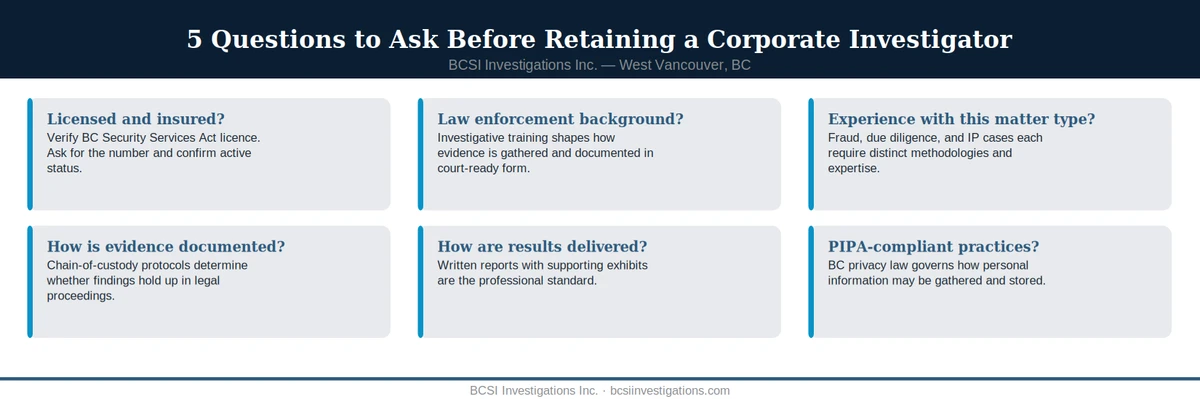
In British Columbia, a private investigator must be licensed under the Security Services Act. That licensing requirement sets a minimum standard. It does not, by itself, confirm competence for complex corporate work.
Beyond the licence, look for:
Relevant professional background. A former law enforcement officer, RCMP investigator, or financial crimes specialist brings institutional training in evidence standards that a generalist may lack. The investigator’s background should connect directly to the type of matter you face.
Experience with legal proceedings. Has the firm produced evidence that was accepted in court, used in arbitration, or relied on in a regulatory process? Ask for the category of matter, not the client name. A credible firm can speak to types of cases it has handled without breaching confidentiality.
A defined investigative process. A capable firm will explain how it moves from mandate to deliverable. Vague answers like “we find what you need” are a warning sign. A defined process exists because disciplined investigators know that improvisation produces gaps, and gaps produce challenges.
Data security and confidentiality protocols. Corporate investigations involve commercially sensitive information. The firm should be able to describe how it protects that information in transit, in storage, and on disposal.
What questions should you ask before retaining a corporate investigator?
The intake conversation reveals more than the firm’s website. Ask these questions directly:
“How do you document your work?” The answer should describe a contemporaneous record-keeping practice: notes written as events occur, evidence captured with verifiable timestamps, and a report format that a court or regulator would recognise.
“Have your reports been tested in legal proceedings?” A confident and experienced firm will say yes and describe the types of proceedings without disclosing clients.
“How do you handle conflicts of interest?” Corporate investigations frequently touch third parties with whom the firm or its investigators may have prior relationships. Conflict screening should be standard.
“Who will lead the investigation, and what is their background?” Firms sometimes assign senior names to marketing and junior investigators to casework. Confirm the actual lead, their credentials, and their track record.
“What will the deliverable look like?” You should receive a written report, organised to a standard that counsel can work from, not a verbal summary or a pile of unsorted materials.
How does a corporate investigator build a litigation-ready record?
The investigative record in a corporate matter typically draws on several streams: open-source intelligence (OSINT) and public records research; document review and analysis; financial tracing; interview and witness identification; digital forensics where applicable; and, where circumstances justify, surveillance under a defined lawful mandate.
Each stream must be handled to its own evidentiary standard. Financial records require chain of custody. Digital evidence requires preservation of metadata. Interviews require documentation of the circumstances, the questions asked, and the responses given. A corporate investigator who does not treat each component with the same rigour as the whole is producing a record with predictable gaps.
BCSI runs every corporate mandate through a defined investigative process, documented at each stage, and delivers a report built to support legal strategy, not to replace it. The structure of a law firm, the precision of a specialised investigative unit.
What types of corporate matters call for a private investigator?
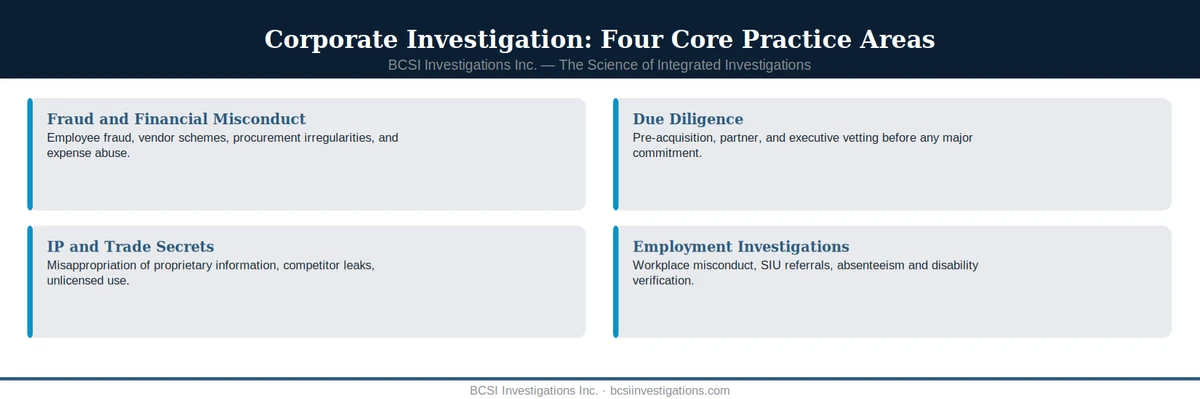
Internal fraud and employee misconduct. Suspected theft, expense fraud, breach of fiduciary duty, or diversion of business opportunity. A private investigator produces documented evidence that supports a discipline or termination decision and, where warranted, a criminal referral.
Due diligence. Before a merger, acquisition, partnership, or significant contract, a properly conducted due-diligence investigation surfaces undisclosed liabilities, prior regulatory issues, or misrepresentations in a counterparty’s background.
Intellectual property and brand protection. Counterfeiting, grey-market goods, and trade-secret theft. BCSI has direct experience in this area, including involvement in significant counterfeiting matters.
Competitive intelligence. Confirming what a former employee is doing with proprietary information, identifying the source of a product leak, or corroborating a suspected breach of a non-compete agreement.
Regulatory and compliance investigations. When a regulator makes an inquiry or when a company identifies a compliance concern, an independent investigative record prepared before disclosure shapes the organisation’s position.
Frequently asked questions
What is a corporate investigator?
A corporate investigator is a licensed professional who gathers and documents evidence in support of a business objective, including fraud investigation, due diligence, intellectual property protection, employee misconduct, and regulatory compliance matters. In BC, corporate investigators must hold a licence under the Security Services Act.
How is a corporate investigator different from an internal HR investigation?
An external corporate investigator is independent and produces a documented record to an evidentiary standard suitable for legal proceedings. Internal HR investigations are subject to concerns about impartiality and may not produce a record that withstands legal scrutiny. External investigation is particularly important when the matter may lead to litigation, criminal referral, or regulatory disclosure.
Does a corporate investigator work with legal counsel?
Yes. Corporate investigation is most effective when the investigator and counsel collaborate from the outset. The investigator produces the evidentiary record; counsel determines how it is used. Engaging the investigator after litigation has commenced reduces what is recoverable and may complicate privilege considerations.
How long does a corporate investigation take?
Duration varies by matter type, the volume of records to be reviewed, and the number of individuals involved. A focused due-diligence review may take days. A fraud investigation involving complex financial flows and multiple subjects may run for weeks or months.
Is the information gathered by a corporate investigator confidential?
A professional firm treats all client information as confidential and applies secure handling protocols throughout. At BCSI, confidentiality is not an option: it is the baseline for every mandate.
Choosing well protects more than the case
The investigator you retain shapes the evidence you have, and the evidence you have shapes your options. Choosing a corporate investigator on price alone, or without asking how they work, is a risk that often surfaces at the worst possible time: when the evidence is tested. BCSI Investigations provides corporate investigation services for law firms, corporations, and financial institutions across British Columbia, Canada, and internationally. To discuss a matter in confidence, request a confidential enquiry. The science of integrated investigations.
About the author: Denis Gagnon is President of BCSI Investigations Inc. and a former RCMP officer with more than 33 years of investigative experience. BCSI is a licensed private investigation firm headquartered in West Vancouver.